
Recently I watched a podcast with Dr. Anna Lembke and Tom Bilyeu centering her book Dopamine Nation. In the book, Dr. Lembke describes how our pain-pleasure system has adapted to never be satisfied, making us always want more, so as to keep us pursuing food in a pre-modern world of scarcity. Now in our modern society of plenty, we are flooding that system with readily available substances and behaviors which throws this delicate balance (Homeostasis) into chaos. Dr. Lembke explains the role the neural-transmitter, Dopamine, plays in our co-located, pain-pleasure pathway; why too much pleasure is actually stressing us out and leads to dopamine-deficit states; how in the long run this decreases our sensitivity to pleasure (needing more and more stimulus for less and less reward) and increases our sensitivity for pain (it becomes stronger for longer); and how all this leads to addictions and robs us of meaning, vitality, and well being. But Dr. Lembke also draws on her many years of clinical practice to reveal how through a life of radical honesty, self-transcendence, and a time of abstinence, we can reset our baseline for a healthier life of balanced expectations when it has gone awol. It is worth hearing at least her concise explanation in this short clip, if not the entire podcast.
Though in the interview Dr. Lembke is given enough space to expound on her research, she was gently and politely resisting the reframing of her conclusions throughout, since Bilyeu had hijacked them before she had said her first word. They continued back and forth, amicably, but she was not able to entirely winnow out his chaff from her grain. With the last words of the interview, Dr. Lembke says, “What I’ve loved about this conversation is how much you and I agree, and yet there is still this strange kind of friction where we don’t agree and I still don’t quite know where it is.” That Bilyeu managed to evade Dr. Lembke’s probes into his work/life philosophy was dissatisfying, and I was left with the urge to have a go myself at working out what was causing that friction.
Though all I know about dopamine is what I have learned from Dr. Lembke’s book and subsequent podcast interviews, I have thought about and wrestled with the issues at the heart of their differing approaches to this information for so many years now, I can’t remember not thinking about it. How it shows up in our understanding of ourselves, our relationships, to the pursuit of excellence vs. perfectionism, growth mindset vs. fixed mindset, and its impact on setting boundaries and when, how and why we do or don’t do that. That dopamine plays a role in this push and pull of our pain-pleasure-motivation system is new to me, but the dilemma has always been there. Essentially Dr. Lembke and Tom Bilyeu are pushing back and forth between the duality of being and becoming. And though Dr. Lembke’s research is incredibly helpful in understanding the mechanics of motivation, how we are pulled forward or stay stuck, these mechanics in and of themselves don’t resolve the issue entirely, as their conversation shows.
Having listened to this interview twice, once while transcribing most of it, my professional layman’s opinion is that Bilyeu has gotten everything upside down. His self-descriptions sound a bit like the reciting of paragraphs from a catechism, principles that he is intentionally applying to reach an outcome. And though these principles in and of themselves are not untrue, they don’t seem to add up in a one size fits all kind of way. On a few points in the conversation, Dr. Lembke remarks that they seem to agree on some basic principles and yet they end up at completely different conclusions, which, understandably, confuses her. I believe this is because Bilyeu has slotted these, almost right, principles under the wrong headings on his work/life’s philosophical ‘canvas’. In fact, they are in reverse order of where they need to be to have a healthy, balanced, and fruitful life.
I say canvas because I often think in pictures. I am a designer, so I know that I haven’t understood something until I can see a picture of how all the different pieces stand in relationship to each other. What follows is an analytical tool to help visualize the different pieces of their conversation and to locate the disconnect.
The Conceptual Canvas
The headings of this philosophical, conceptual canvas, as I’m calling it, are Foundation, Orientation, and the Guardrails. Like the four sides of a rectangular canvas, the Foundation is the bottom side, the Orientation, the top, and the guardrails are the left and right sides. The Foundation refers to the ideas, principles, inner-dogmas, conscious or unconscious beliefs, and assumptions about ourselves and the way the world works upon which our lives are erected. The Orientation denotes what we are reaching for, which direction we are pointed, where we are headed. Orientation is the focal point of our attention, efforts, and resources, and reveals what is most valuable to us. The Guardrails channel the abstract of our values and beliefs into reality by hedging them with the particulars of our life and the context in which we live. In other words, how our foundation and orientation show up in real time and what their impact is on us and the world. These are the four directions or dimensions which form the conceptual canvas or space within which our lives unfold.
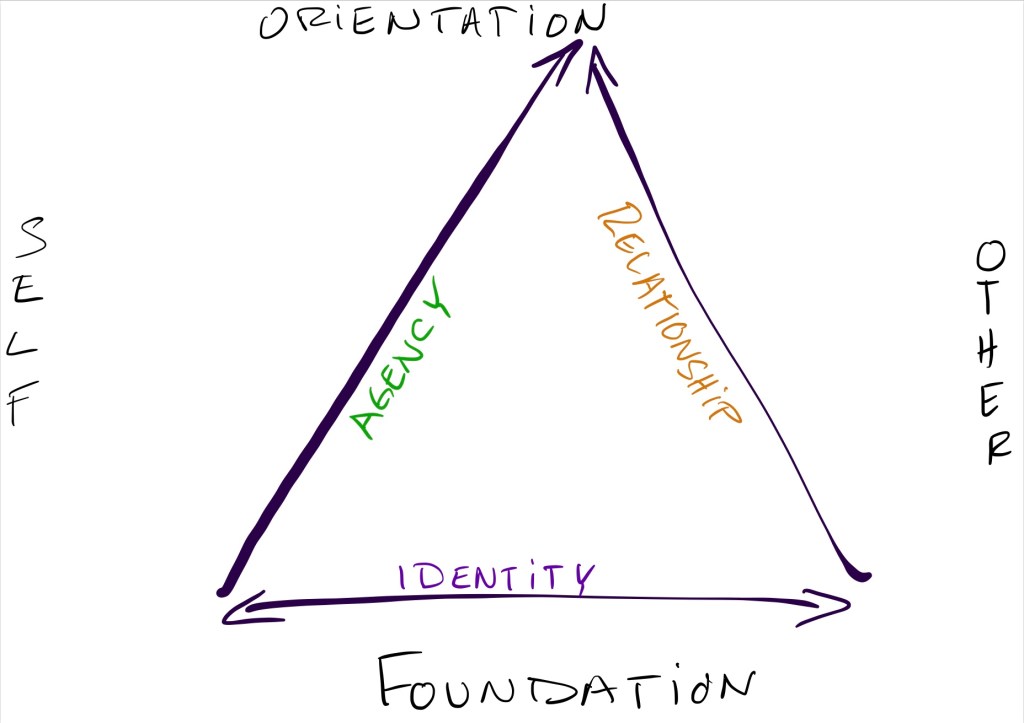
It is within this conceptual space that we try to answer three existential questions about our lives. 1) Am I enough? A question of Being, of Identity. 2)Why am I here (what am I here to do)? A question of becoming, of Agency. And 3) where do I fit in? A question of belonging, or Relationship. I imagine these three existential questions being represented by a triangle on our larger conceptual canvas. But it is how we “draw” our triangle in this space that makes all the difference, as I plan to argue.
The Conceptual Canvas Applied to Bilyeu
His Foundation
Bilyeu is a You-Tube, life and business coach, who appears to be a start up, go-getter kind of guy. Throughout the conversation Bilyeu talks openly about the beliefs, methods, and systems upon which he constructs his life. He is especially excited by this research because it confirms the path he had taken out of his own stuckness, which he did by hacking his Dopamine-motivational system. The most important thing, he explains to his guest, the dopamine expert, is the pursuit. Dopamine is about wanting something, and he has “become good at tying wanting something to a flood of dopamine.” His own life began to change when he realized that his brain is a chemical cocktail which could be managed by ensuring that he attaches his internal rewards only to sincere pursuit and not to actually attaining any specific goals. In this way, Bilyeu believes he can create a self-perpetuating motivation for a productive life. He gives himself those internal rewards, kudos, (I’m ok!) for working long and hard (striving) toward the goal, even if his particular efforts have failed. At a later point in the conversation, Dr. Lembke observes that Bilyeu sets a lot of stock in his will, which Bilyeu confirms saying, “I worship my will.” Bilyeu’s foundation is a belief that through striving, exercising his will, and cleverly manning his biological systems, he can orchestrate a worthy life which others will want to emulate.
His Orientation
Key to sustaining this motivational loop, Bilyeu expounds further, is having a goal that is so far away, that he will always have something to strive for and not risk attaching rewards to the actual attaining of something. One must set a “North Star,” a goal so high and unlikely that it sounds absurd to anyone who hears it. This is Bilyeu’s orientation. What he pours his time, energy, efforts, and attention into. It is the measure and crucible for deciding both what trade offs he will make throughout his life, and when he can stop pursuing, or in his case, striving. Bilyeu’s “unattainable” goal? To be the next Disney.
His Guardrails
But after push back from Dr. Lemke that this sounds like a recipe for addiction, Bilyeu offers qualifiers to this goal. Since nature crafted humans to be the ultimate seekers, quoting Dr. Lembke, Bilyeu recognizes that we have to choose wisely what we seek. The goal must be exciting (something to get us out of bed) and honorable, elevating rather than harming ourselves or others. With these guardrails, Bilyeu makes the case that he can evade the trap of addiction that this modern eco system of abundance poses for our ancient reward-deficit pathway.
Gentle Pushback
Dr. Lembke’s intuition was to be skeptical of Bilyeu’s ambition right from the start of their interview, and more than hinted that this sounded like a kind of addiction in and of itself and not the balance that she is advocating for in her book. Her own personal conclusion to her research and extensive clinical experience is that, though it is good for us to do hard things, it is not about ‘striving,’ working harder and longer, to reach some specific goal, no matter how far away, but more “doing the small things,” and in calibrating the immediate of our lives in being present, intentional, and having realistic expectations about how hard and difficult life can be. Life can be a drudgery, Dr. Lembke admits, is filled with hardship, and is costly, and we should resist the urge to escape that pain by indulging in easy to access and potent dopamine providers (alcohol, drugs, sex, porn, work, food, our phones, binge watching, body modifications, novelty seeking, high-risk activities, etc). She pushes back against the prevailing message of our time, that the goal in life is to always be happy and feel good, and that pain, effort, and suffering are things to avoid, overcome, hack, and medicate any way possible.
As I watched and then studied their conversation, I found myself not only drawn to Dr. Lembke’s person and manner, but also in agreement with her intuitive suspicion that something wasn’t quite right with Bilyeu’s life strategy, even though many of the things he said also ring true. Though how Bilyeu lives his life is none of my business and he has certainly not asked me for my thoughts, there are so many Bilyeus out in the world, and their message is so pervasive, that I feel almost compelled to “fix it.” In a nut shell, I think Bilyeu’s existential triangle needs to be flipped inside the conceptual canvas of Orientation, Foundation, and the two Guardrails.
Problems with His Orientation
Bilyeu is almost right in his wisdom to have a goal so far away that he knows he will never reach it in his lifetime. That means there is always movement and progress. There will never be a moment where he doesn’t have some reason/motivation to take another step forward, solve another problem, move into new territory. That is the basic precept of the Growth Mindset. There will always be another step forward, another horizon. It keeps us from becoming bored, complacent, smug, stale, stagnant…and dead. And it keeps him moving for sure. In another interview, Bilyeu reveals that he has optimized his work week at 93 hours! 94 hours would be too many, but 93 hours is just the right amount for him, he assures.
But I see at least three problems with Bilyeu’s hack. First, and most obvious to me, is that Bilyeu’s “North Star” is too Close. It is not nearly far enough away. It is more like the Moon than a North Star. The moon is unattainable for most of us, but some have actually made it there. He could, theoretically, actually become the next Disney (whatever he thinks that means, I can only guess). It is a goal, not a fixed point by which to navigate. I have never heard of anyone navigating by the moon. Presumably, even the real Disney navigated by some other celestial marker much farther off than any of the milestones he, himself, reached.
Second, it fails the North Star test because it is Comparative. Actually what Bilyeu is saying, is that he wants to tie a record that has already been broken, or maybe actually break that record (be even better than Disney?). It is two very different things to navigate your ship by the North Star on the open seas of the reality of this earth in the here and now, than it is to try and get to the North Star, or in his case, the moon. The second is a race. He is saying he wants to occupy a singular, rarified place in the future history of mankind. The person who ushered in a new era (receive the one gold medal). That of course means he would have to cross that finish line first (a race against time). In order for him to be the next Disney, no one else can be (a race against others). Anna Lembke recognizes and reflects back to Bilyeu that, “I think where the gap is, is that the thing you are trying to get is a materialistic, king of the mountain kind of thing. ‘I am going to be king of this mountain.’” It is a measure dependent on scarcity. There is only space for one at the top. The measure used to define success is still other people. The standard they have set, the mould they have created, which is static rather than dynamic, since it is already finished, and will never suit someone else entirely, never be a perfect fit for anyone else.
Third, it is too Cramped. In a number of ways, Bilyeu’s goal of becoming the next Disney, in all its outlandishness, is not broad enough. Its scope is too specific and narrow.
• Picking this one spot on the horizon and focussing solely on it has the danger of being an Inflexible Tunnel vision. It excludes multiple other spontaneous or important and urgent ways of being and serving that may be presented to him in the course of his life that might need to be prioritized over his becoming the next Disney (Olympian, Academy award winner, Steve Jobs) in any given moment. Whether changing the diapers of a new born, caring for a sick parent, helping someone who has been left for dead by the side of the road, or his own needs for recreation and connection. How does such a North Star help him navigate the kind of son, husband, friend or father he wants/needs to be?
• It is Elitist and Exploitative. Since decisions and action are always defined by an Image in the future rather than a present, observable or expressed need or curiosity, other individuals, community, society, and the planet are excluded from giving input into what his priorities might need to be at any given moment, or even in what a worthy vision might be to begin with. At one point in the interview, he says he believes in a collaboration of equals and wants to create a culture of good soil for honest feedback. However, he is creating this only in the context of serving the goal he has already committed to- only as an extension of his self-Image of being the next Disney- which is, in essence, an ego image. That is not the same as a collaboration of equals toward a more universal understanding of the Good for all, which includes what is good for others also. There is, at the very least, an element of exploitation involved. Is the world crying out for another entertainment empire? Is that all that the people closest to him, or impacted by him, need him to be?
• It is precarious. It is based on a fixed and specific set of circumstances which could change at any moment. The wording for a North Star kind of orientation should be something that we can pursue in any circumstance, at any time, in all places, with anyone. If he was in a plane crash on a deserted island, would his North Star give him orientation? Would it help him know what needed to be done, and what was needed from him? Would he be able to recalibrate and allow the immediate and expressed needs of the circumstances, together with his competences and resources, chart the course for decision making and action? I am not saying that he should not pursue what may actually be a good thing for him to pursue. I am saying that this is not tall enough to be the center tent pole of his life because it does not make space for all the other good he may want or need to pursue over the course of his lifetime.
Ultimately, his goal is an Identity, to be the next Disney, to be the next man on the moon, king of some mountain, the next olympic gold champion, the next mother Theresa, the best Mom on the block. To be the North Star. When we make our identity, even our future identity, even one we believe is unattainable, even if we believe it serves mankind on the grandest of scales, our orientation, it never actually serves anything outside of ourselves!! We are serving our own ego, Hubris, and no one else. No wonder the attaining never brings him satisfaction, because striving for an identity never does. The “rewards” just fall out of the bottom, because there is no foundation based in the reality of his actual and true present self. It is an ego goal. His answer to the question, “who am I?” is, “I am the next Disney in the making.” His identity is defined only in relation to the idea he has of himself, rather than to the accumulation of circumstances, experiences, choices and relationships that have been his life thus far, or even how he is showing up in that very moment and the impact he is actually having currently.
Whether or not he ever attains the goal, in his mind, his identity is about what he will fashion himself to be, not what he is or was, but about what he will make happen. Either it will become a “fixation”(compulsion) urging him to hurry ahead of his own pace, ignore his own limitations, or it could quite possibly become a defining limitation, putting a cap on how far he feels he must go. In that case, it becomes a brittle fixed identity, limiting him to become only that thing, becoming overly sensitive to anything that might question him or challenge him to become more or something else. The hustle to prop up/maintain and defend that identity is his Dopamine addiction, his hedonic treadmill.
Problems with His Foundation
Whenever our understanding about ourselves is based on a projected image, either an idealized portrait we curate or a future self we strive toward, then that becomes our orientation, the thing we pour our attention, time, energy, and resources into creating and validating. It becomes the measure by which we judge not only our real/present and past self and our contributions, but also others and their contributions, as well as their honest and constructive feedback about our real selves and the impact we are actually having on our environment. Having an identity as an orientation makes us extremely fragile and unstable, like a triangle standing on its tip, easily tipped over into shame. There is simply too little grounding in reality to give it the secure base it would need to not be easily rattled by the opinions, otherness, or push-back from the world around us.

To flip that triangle onto its base would be to recognize that the only stable Foundation we can have, the starting place for everything that is then built, is the awareness and acceptance (rather than denial) of who we actually are. To radically embrace and show solidarity with the truth about ourselves and the real impact we have in the world is the only stable foundation for any kind of transformative growth. It is the AA member’s “Hi my name is Bob, and I am an alcoholic,” to Bilyeu’s, “Hi my name is Tom, and I am the future Disney.” Tom’s identity is aspirational, an orientation. Bob’s identity is foundational. Whatever the future holds for Bob, it includes and doesn’t hide his past and present self and is still open for whatever forces, choices, and serendipity may yet play their part in it.
In place of a foundation, Bilyeu has constructed a scaffold which keeps his ‘triangle’ erect and from tipping over into shame. In listening to the interview, I could not help feeling that Bilyeu’s scaffold was cobbled together with a collection of truisms, management advice, and current research, like Dr. Lembke’s on dopamine, not unlike using inspirational post-it notes to wall paper your house. Some of the poles of Bilyeu’s scaffold are his beliefs that through striving, exercising his will, and cleverly manning his biological systems, he can orchestrate a life worthy of approval, emulation and perhaps admiration. Dr. Lembke, in stark contrast, seemed to be the very embodiment of the concept grounded. Throughout their conversation, she remained rooted in her own thorough research, decades of clinical experience, and radical self-awareness, while still remaining flexible enough to genuinely listen for, mirror, and find overlap with Bilyeu. It was truly inspiring to watch her.
The more aware, truthful, and accepting we are of our limitations (biological, time, space, matter, conscience, abilities, resources), our organic nature (our needs, potentials, and vulnerabilities), and our impact (of what we think and believe and how we act on the world), the more secure our grounding will be. The more aware, truthful, and accepting we are of these realities outside of us, the better able we will be to navigate them successfully. We may argue and dialogue with each other over what is really true, but the proof will be in the pudding. The one who builds their life on the rock of reality, which is how truth usually shows up, has no need to fear that questions, otherness, setbacks, or pushback might take out the pillars of such a scaffold.
Problems with His Guardrails
Bilyeu’s attempt to qualify and give safety-rails to his ambition are in part miss-placed and in part miss their mark. In order to be successful and relevant, and avoid both motivational entropy and the treadmill of pursuit, Bilyeu offers these guidelines: the North Star goal one chooses must be both exciting (something to get us out of bed) and “honorable, elevating rather than harming ourselves or others.” In theory, that rules out choosing things that would spiral into addiction or peter out into less and less satisfaction. In practice, we must remember, and Bilyeu should too, that he admits to working 93 hours a week, has no friends, and, besides his wife, no family.
Bilyeu’s use of the adjectives, exciting and honorable, are misplaced in this part of the conceptual canvas, because they are simply more values and not concrete particulars of reality. Without realizing it, he has placed these two values as watchmen over his “North Star,” north stars to his north star, or as I mentioned earlier, his moon. This should clue us in to what kind of thing should actually be the celestial marker by which we can assess our current location and navigate forward growth, as well as weigh the worthiness of the mile-markers and landmarks we choose to move towards.
However, Bilyeu is not completely off track in the guardrails that he offers. By instructing us to choose a “North Star that elevates rather than harms ourselves or others,” Bilyeu comes closer to hitting the ball on the green. Earlier I wrote that “the Guardrails channel the abstract of our values and beliefs into reality by hedging them with the particulars of our life and the context in which we live. In other words, how our foundation and orientation show up in real time and what their impact is on us and the world.” No matter how good our values and beliefs appear on paper, it is the living of them in the here and now of relationship that will ultimately reveal their true impact. This makes ‘self’ one of the guardrails, and ‘other,’ everything that is not us, the guardrail on the other side of our conceptual canvas. At the end of the day, what matters is not how lofty and noble our ideological castles were, nor how logically neat and tidy our dogmatic house of cards may be, nor even how closely we adhered to either one, but rather what matters is if we and those around us actually flourish. As you might imagine, the “guardrails” turn out to offer a much more dynamic process than their image conjures up, as they insist that moving forward into more truth and goodness is a continual negotiation as we reach out to the other for connection and intimacy. This does not mean that Truth and Goodness are negotiable, only that our finding them in authentic connections will entail negotiating between our internal and external worlds. Self and other are the sheep dogs for abstraction, if you will.
A Look at Both Triangles
To bring this all together, I want to put Bilyeu’s existential triangle with the sides Identity, Agency, and Relationship, on our conceptual canvas. Just from what Bilyeu reveals about himself in this conversation, it sounds that he has drawn the identity side of his triangle on the top of the canvas, Orientation, meaning it consists of an idea, an image, or a delusion that must be maintained from within and from without. This leaves the sides, Agency and Relationship, to come together in a point at Foundation. This is an inherently unstable structure, like building a roof before the house. The efforts and successes of his agency and his relationships all serve to keep this triangle propped up and stable, and therefore, ultimately serve his idealized image (hubris). Also, since the foundation is missing, all these efforts are going into filling a cup without a bottom, or in other words, a vortex or funnel, which is the opposite of growth. There will never be enough validation, and therefore questions, otherness, and pushback can easily destabilize the system and throw it into defensiveness and a shame spiral.

Identity as Integrated Foundation
To flip this triangle is to plant the identity side of the triangle on the bottom of the canvas, Foundation, with the two sides pointing up toward Orientation. Here, identity forms a solid base because it is grounded in the truth of what is. The person with this triangle is unflinchingly committed to pursuing and embracing (as opposed to living in denial) the truth about self without shame or condemnation. Because they are already sure of their worthiness to exist and take up space in this world in their unique way, they are able to face and take responsibility for their limitations, their potential, their needs, their vulnerabilities, and the impact they have on others. The person with this triangle experiences internal cohesion because there is no discrepancy between the truth of who they are and the idea they have of themselves. This is often called wholeheartedness because one is not divided between being loyal to an image and being loyal to the reality of self. This triangle represents an identity of integrity, since, as it grows, it remains a solid structure, having no gaps between what is and what is projected outwardly.
Seeking Self-Transcendent Values
The two sides of the triangle, Agency and Relationship, rise from this foundation. As we pursue the Good (for ourselves and others) through our agency, we experience transformational growth. This is a natural and organic byproduct of focussing our attention and energies toward seeking self-transcendent values. To seek the Good means to go through life with that hunter-gatherer mentality looking for and consuming that which will truly nourish our mind, heart, and body. Because the person in this triangle is seeking self-transcendent values, ones that are infinite and eternal and serve something outside an ego-image, there is no scarcity to fight over, no running out, no finish line to hurry toward, and no winner’s circle in which to hang out and get comfortable. There is always more truth, goodness, and beauty to move toward, uncover, and contribute to the world. And because these values are truly nourishing, giving us what we need to reach full maturity and fruitfulness, they motivate us to continual pursuit without the danger of addiction or compulsive over-consumption.
A Harmony of Just Relationships
As we seek a harmony of just relationships, what I have been calling Beauty, between ourselves and the people and things around us, we experience intimate connection. The person in this triangle knows that others also have limitations, needs, vulnerabilities, potential and agency and is present and aware enough to see these and respond in ways that encourage their transformational growth toward maturity and fruitfulness. That will mean nurturing, protecting, empowering, and collaborating (co-creating) with others, just as it will mean holding them accountable to do the same. The person in this triangle is neither driven by a desire to be king of a mountain, nor lured by a desire to remain dependent and coddled, but rather is motivated to action by a deep longing to both be known and to know the other in an intimate connection of mutuality. The more we truly see and engage each other in this way, the more we experience intimate connection and the deeper our sense of belonging becomes.
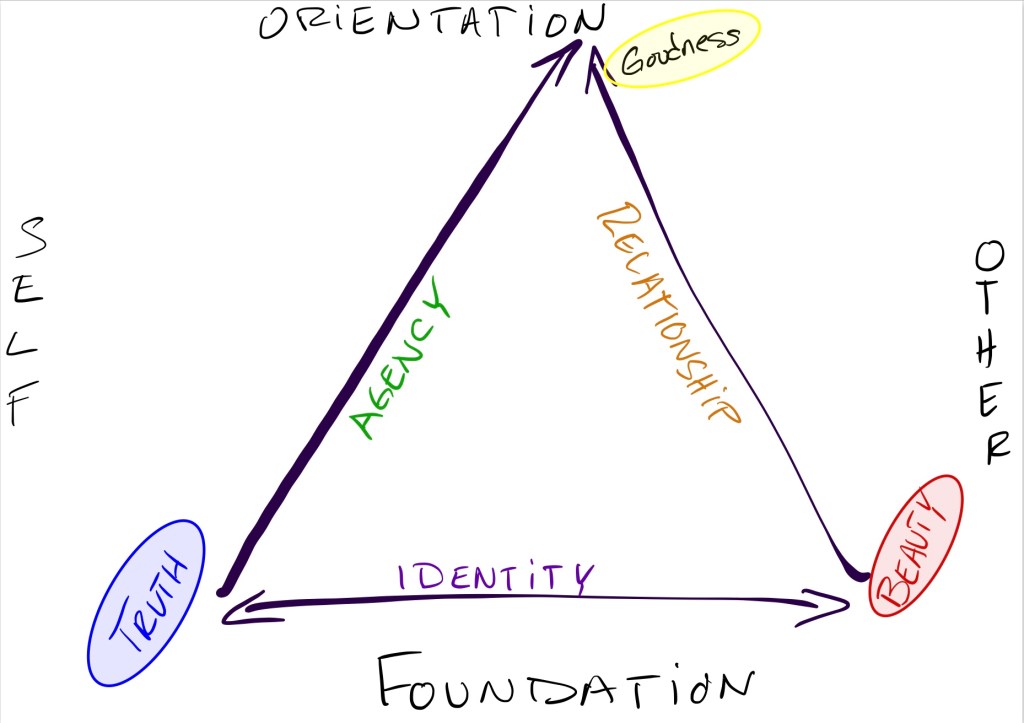
Because there is a solid foundation, the more we make truth, goodness and beauty our orientation and pursue them in any and every circumstance, the more our triangle grows, or rather, our life flourishes and so do those around us.
The Crux of It…
At this point it is important to remember that I am offering these triangles on this conceptual canvas as an analytical tool to uncover the disconnect between Tom Bilyeu and Dr. Anne Lembke in their conversation and not to make general assumptions about what really grounds or drives Bilyeu or what kind of impact he is actually having in his life as a whole. I am fully aware that it is not my place to stand in judgement of him. It may be that Bilyeu actually has his triangle right side up and only talks about it in a confused and wonky way. My guess is that he, like all of us, is a mixed bag of both triangles and is doing his level best to figure it all out. But since he is publicly proselytizing his work/life philosophy, it is my duty to myself to investigate and evaluate if what he says here in this interview is worthy of emulation. I think we do ourselves a disservice if we don’t carefully think through our core values, our self-perception, and what we want from others, and the language we use can either help or hinder us in that process. Using this tool helps me to see that, though it often seems that Bilyeu and Dr. Lembke use similar vocabulary, “it’s about the process,” “North Star,” “truth telling,” “doing hard things,” among others, they end up having different outcomes because they appear to be operating from opposite, existential frameworks. Dr. Lembke argues for the stability and balance that comes from being grounded in accepting the truth about our identities and moving forward in a sustainable pace from there. Bilyeu is advocating for a life of chasing the moon.
Only one question remains: How can these triangles help me?
My attempt to answer it is in Part II.
 It Takes One To Know One
Pingback: My Striving and Me (part II) | It Takes One To Know One